Ephemeral Process Boundaries and the Hidden Failure Modes They Create for Autonomous Agents
Serverless execution loses agent state between runs.
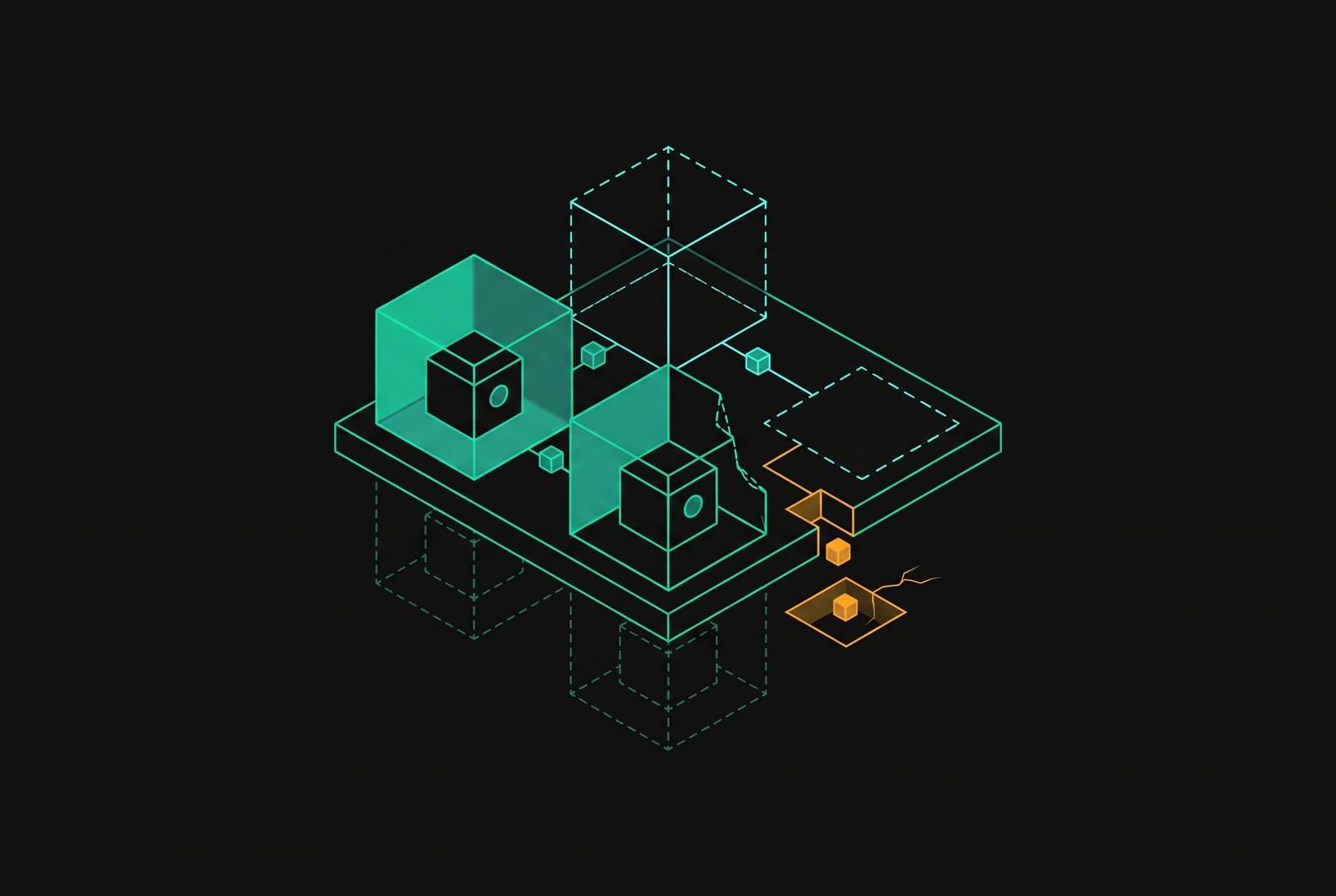
Persistent AI agent infrastructure preserves the working state that serverless functions cannot retain on their own across recycled invocations. For autonomous agents that run across minutes, hours, or sessions, that difference decides whether they pick up from prior work or only seem to. Ephemeral process boundaries cause predictable failures in context, authority, and completion, so agents need durable state and per-agent isolation to work reliably without rebuilding state over and over.
Why serverless functions are the wrong foundation for stateful autonomous agents
A process receives a request, produces a response, and discards its intermediate state. That design enables horizontal scaling and fault tolerance without coordinating working state between requests. It suits the job. Developers borrowing the same execution model for agents, however, inherit an assumption that does not hold across an autonomous task.
An agent’s next action depends on accumulated state. Its run can span minutes or hours, hold open LLM sessions and tool connections, and adapt as tools return results. Jinhu Qi and colleagues’ 2026 survey, “Towards Trustworthy Agentic AI: A Comprehensive Survey of Safety, Robustness, Privacy, and System Security,” distinguishes a model that returns text from an agent that plans, stores intermediate results, and chains actions. Each interaction changes the agent or its environment. Treating that sequence as independent requests gets the architecture wrong in a way that a library or configuration setting cannot fix.
What "ephemeral process boundary" means in practice for a running agent
An ephemeral process boundary occurs when a running agent’s in-process state is discarded and not restored when execution resumes. That state includes working memory, open tool connections, reasoning chains that are only partly done, and cached credentials. When a container or function instance is recycled, those resources do not pass to the next invocation on their own. The process restarts, but the task has not restarted. Changes already made to the environment can remain even when the agent’s knowledge of them disappears.
Consider an agent partway through a multi-step code refactor. It has modified files when its process is evicted, then resumes without knowing which changes it already made. The goal remains available, but the execution history does not. Re-prompting can make the continuation sound coherent without restoring the missing context. The agent can therefore act confidently on an incomplete account of its own work, while nothing flags the missing state as an error.
That silent resumption is more dangerous than a visible crash. A crash reports that execution stopped. A continuation without state can report progress while taking the wrong next action. The boundary separates what happened from what the agent knows happened.
Five named failure modes that emerge specifically at process boundaries
Context bleed occurs when a reused process slot exposes one tenant or session to another’s residue. Without thorough cleanup, workspace files, cached secrets, or in-memory context can be left behind, giving the next agent information that does not belong to its task. This differs sharply from losing context altogether. Context loss leaves the agent with too little information, while bleed gives it the wrong information without identifying it as such. The Microsoft AI Red Team taxonomy v2.0 adds “session context contamination” in April 2026 as a distinct failure mode.
Scope creep occurs when a restart preserves the goal but loses the constraints negotiated during earlier steps. Without a lasting record of authorized scope, each session can widen the action envelope beyond what was first allowed. The goal alone is not sufficient authority. The taxonomy identifies “excessive agency” and “incorrect permissions” as compounding failures in agentic systems. Process boundaries make those risks harder to contain when the permissions and limits governing earlier actions do not reliably accompany the next session.
Silent completion occurs when an agent declares success from the partial work it remembers. The missing state may include steps that are still unfinished or signs that the task is still broken. The completion signal can still look normal. In a multi-step workflow, downstream agents or processes may accept that signal and proceed as though their preconditions have been met.
Cascade error begins when a wrong tool call contaminates subsequent steps. The survey identifies this propagation as a structural property of agentic systems, where later actions depend on earlier results. Ephemeral execution makes recovery harder by removing the durable record of where the mistake began. An unfamiliar case can then become progressively more damaging. Unlike a chatbot that gives a worse answer under distribution shift, an agent can take a sequence of confident actions that worsen the situation.
Model drift, treated here as a temporal-validity failure, is a change in how an agent behaves over runs that span days or sessions. Re-prompting noise, approximate context, and reconstructed assumptions can move behavior away from the initial specification even when the model itself is unchanged. Authorization can drift out of date as well. The survey identifies agents acting outside the valid time windows of approvals, authority, or policies as a structural failure class. Lost authorization state can leave a resumed agent acting on a lapsed approval.
How these failure modes compound rather than occurring in isolation
Context bleed can supply the wrong assumption for a tool call, beginning a cascade. If the agent then loses the record of unfinished work, it can log partial progress as complete. A downstream agent receives that false completion signal and proceeds. The error now spans two agents’ states and two process boundaries. A review of any single step can miss the chain because the misleading input, incomplete work, and downstream consequence sit on different sides of those boundaries.
The taxonomy describes attack chains and compound effects as the norm. It also identifies inter-agent trust escalation, in which a compromised agent asserts a false identity or inflated permissions to an orchestrator that does not independently verify them. A downstream system can inherit not only an incorrect result but also an unjustified claim about who may act on it. Repeated boundary crossings consequently create an accumulating deficit of reliable state.
Why these failures stay hidden until they are already expensive
Most agent benchmarks measure task completion while leaving adherence to constraints throughout execution unexamined. A successful outcome can therefore conceal repeated violations along the way. The survey identifies runtime monitoring as a major unresolved challenge because most deployed agents lack continuous checks of execution traces against safety rules. Release tests capture only a point in time. They do not establish that an agent will preserve its constraints as context changes across sessions.
The observability gap begins with the missing record. When execution state exists only inside an ephemeral process, recycling that process removes the history needed to explain its decisions. External logs may show what the agent did without recording its reasoning state. More monitoring cannot recover state that was never persisted. Post-incident reconstruction must instead infer how the agent reached a decision from signals that were not designed to preserve that continuity.
Gradual degradation makes this absence harder to detect. The taxonomy adds “degradation of agent performance” as a downstream effect, recognizing that compound failures need not first appear as discrete incidents. An agent may continue producing outputs while their quality decays. By the time a threshold-based alert fires, the failure can already have spread through later actions. A pass/fail view of execution obscures precisely the deterioration that durable traces would make available for review.
What the performance record shows when agents actually run across time
Standardized benchmark runs that span days show that agents fall well short on tasks that need continuity. Performance weakens as work extends across time and depends on prior actions. This fits the diagnosis of a flaw in the structure, because each lost state transition leaves later work to rely on a partly rebuilt history.
The comparison concerns both infrastructure and model quality. The same underlying model behaves differently depending on whether its execution environment preserves state across the task horizon. That makes continuity a controlling variable in the reported performance pattern. These outcomes show why doing well in a single session is not enough to prove that an agent can work reliably on its own, and why comparisons between persistent infrastructure and serverless functions must look at both state preservation and inference quality.
How persistent, isolated execution environments eliminate the root cause rather than patching symptoms
A long-lived, isolated runtime removes the state-discarding boundary from the agent’s task horizon. Instead of asking each invocation to reconstruct what happened, the runtime preserves the working state required for continuation. This addresses the forms of the five failures that process boundaries cause. It restores the continuity whose absence enables or amplifies wrong tool calls or unauthorized actions. Better prompts cannot substitute for a record of work and authority that execution has discarded.
The stateful agent runtime pattern separates reasoning from persistence. A durable, versioned state store maintains working memory, the goal stack, and tool usage history, while the reasoning engine remains stateless and interchangeable. Models can then be swapped without losing continuity. The runtime owns state across the full task. Compared with a stateless request-response loop, it makes continuation an infrastructure property.
Persistence also needs a strict boundary between agents. A reused workspace can preserve the wrong tenant’s files or secrets just as readily as it preserves useful task context. Persistence addresses loss, while isolation addresses bleed.
Snapshot and restore make this model economically viable. When an agent goes idle, its VM state can be snapshotted to fast local storage and restored on the next request, avoiding continuous consumption of idle compute. Because most agents are idle most of the time, storage becomes the appropriate pricing primitive for those intervals. The operational constraint is equally concrete. The same snapshot must never be resumed twice, because doing so would duplicate identifiers, entropy pools, and tokens.
What governance looks like once the infrastructure problem is solved
Durable execution state makes governance tractable, but it does not decide what an agent should be allowed to do. Gartner’s 2026 report identifies a failure in treating governance as a binary choice between locked down and fully trusted. Agents work at different autonomy levels and across different trust boundaries. Controls must reflect both autonomy and access. Infrastructure preserves the evidence and state needed to enforce those controls, while governance defines the permitted action envelope.
Gartner describes four levels, namely Observe, Advise, Act with Approval, and Act Autonomously. Agents with less autonomy mainly risk context loss and silent completion, while those with more autonomy also risk scope creep, cascade error, and temporal-validity failure. The failure surface expands with permission to act. Governance should match how much autonomy each agent has, with trust decided for each deployment. A durable record of approvals is especially important when action may occur in a later session than authorization.
Persistent infrastructure makes approval workflows with audit trails and rollback capabilities implementable for Level 3 and Level 4 controls. Without saved state, those controls have no history to audit or restore. Infrastructure and governance are therefore complementary investments. Agents that persist, isolate, and retain durable traces are the minimum viable substrate for autonomy that can be governed, audited, and trusted at production scale.