What Serverless Execution Environments Take Away From a Running Agent
Serverless functions discard the continuity agents need to complete multi-step tasks.
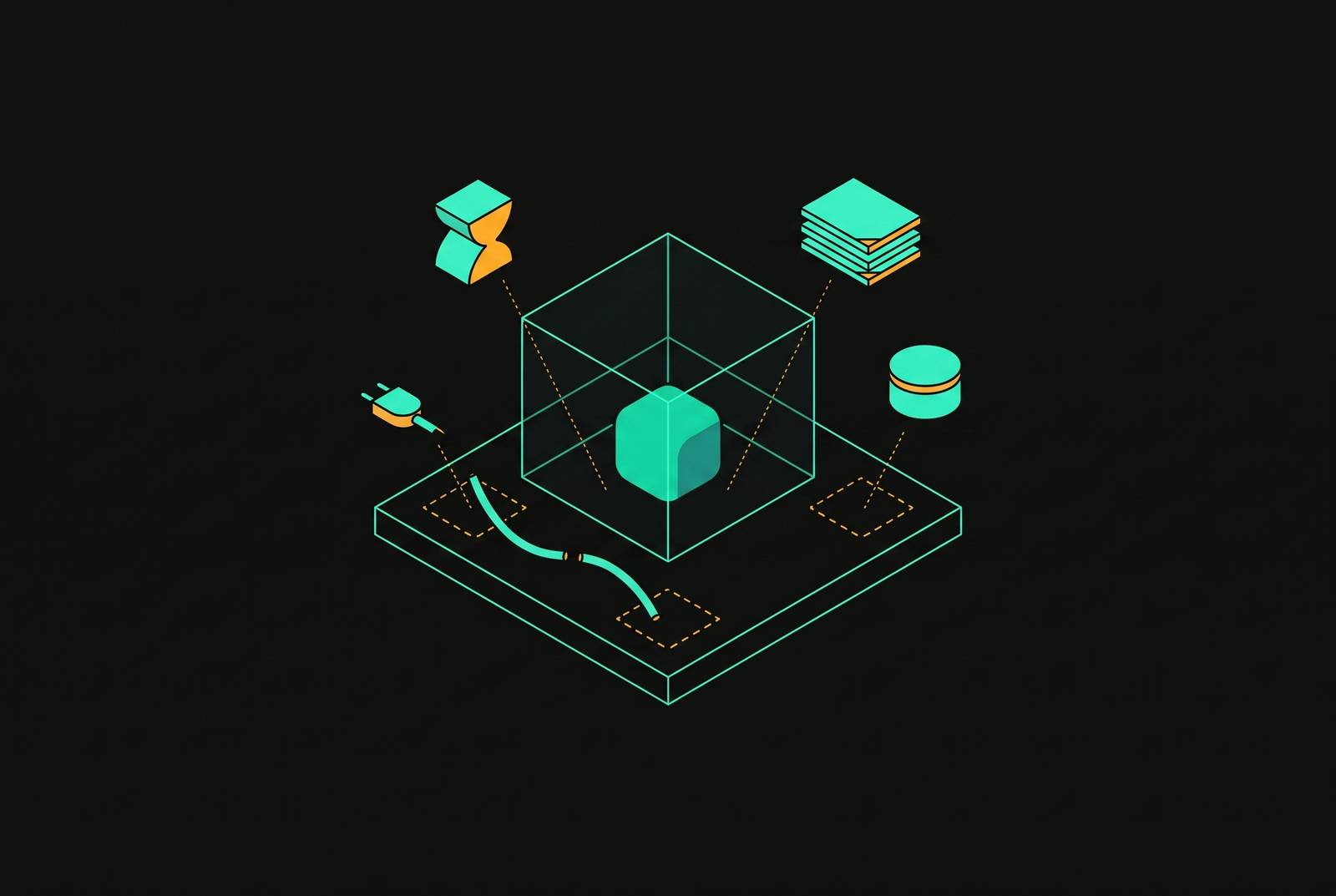
Serverless execution environments take away the continuity that autonomous, multi-step agents need through hard timeouts, disposable local state, and repeated initialization. Persistent AI agent infrastructure differs from serverless functions by preserving a worker’s workspace and execution state between active periods. The architecture must keep that continuity without tying up compute all the time, with strong isolation and fast snapshot restore.
Why are serverless functions a different kind of workload fit than persistent AI agents?
A serverless function is meant to run for a short time, after which its local environment can be discarded. An agent works through a series of linked steps, and what it does earlier shapes what happens next. Its installed packages, intermediate files, and accumulated context belong to one continuing task. That difference changes the unit of correctness. A successful invocation is not enough if the agent cannot continue from the work it just completed.
The mismatch follows from who controls the environment’s lifetime. Under the serverless contract, the platform allocates the environment on demand and can reclaim it when an invocation ends. The agent, by contrast, needs its workspace to outlive any particular tool call or interaction. Its work may span seconds to minutes, and the full sequence needs to remain observable as a continuous unit.
AgentDecarbonizer’s workload analysis found that input tokens make up the vast majority of the tokens processed in agent runs. Context caching eliminates recomputation for the large majority of those inputs, making reuse central to efficient execution. The constraints below map what disappears when a continuing worker is forced into disposable invocations.
Hard execution timeouts and what they cut off mid-task
Hard invocation limits turn uncertain task duration into a correctness problem. Software repair, data analysis, and multi-step code review may take longer than a platform allows them to run. When a task runs longer, the invocation ends rather than becoming a suspended worker ready to resume. The unfinished task has lost its running process. This is different from a slow response because completion now depends on recovery outside that process.
To survive that boundary, the task must be divided into invocation-sized chunks with coordination between them. Queues, state stores, and retry handling must be part of how the work runs, so it can no longer treat them as optional supporting services. Without that layer, a long task can fail without producing its intended result. The platform’s time limit remains fixed while the application absorbs responsibility for continuing the work.
Step Functions and Durable Functions provide the standard durable-serverless response to this problem. They can orchestrate work across invocations, so timeouts do not make long-running workflows impossible. But they recreate continuity through indirection. Coordination logic, persisted state, retry handling, and version management must take the place of a process that stays alive for the whole task.
State erasure at every invocation boundary
Installed packages, cloned repositories, loaded datasets, and in-memory context cannot be assumed to survive into the next request. Even a successful invocation provides no guarantee of environment reuse. The next step therefore needs a defined way to recover. Otherwise, it depends on local state that the platform is free to discard.
AWS resets the Lambda execution environment after a timeout, although the /tmp directory is not cleared by that reset. That exception is important because state loss is not literally identical for every part of the environment. A directory surviving one reset is different from an agent being guaranteed the same filesystem and process state when it resumes.
For a PR review agent, cloning a large repository can add over two minutes before analysis begins. A stateless deployment that rebuilds the workspace each session repeats that preparation. Conversation history, tool outputs, and task goals must be stored elsewhere and reconstructed or fetched again, while loaded data and process state require their own restoration. State erasure is not a platform defect in this model, but a consequence of treating the execution environment as disposable.
The re-initialization tax agents pay on every cold start
Rebuilding that environment consumes time before the agent can advance its task. Image loading, filesystem preparation, namespace configuration, and the runtime handshake are prerequisites for tool execution. Repeating them across a multi-turn workflow makes setup a recurring expense. The delay accumulates on the critical path. A sequence of individually modest initialization costs can therefore degrade the responsiveness of the complete task.
That result applies specifically to those workloads and baseline systems. It nevertheless makes the rebuilding cost concrete. Container re-initialization can dominate cold-start latency in agent workloads because the environment being reconstructed is part of an evolving computation.
SpecBox identifies the same dependency in sequential reactive workflows, where sandbox preparation can sit entirely on the critical path. GPUs generating tokens must wait while CPUs initialize the next sandbox. Completed inference cannot advance the workflow until the execution environment is ready, while CPU resources are occupied rebuilding conditions that a persistent runtime could retain. Provisioned concurrency mitigates cold starts by keeping environments warm, but introduces a baseline cost during idle periods.
What stateless invocations cost in inference calls and context cache misses
Agents reuse task goals, conversation history, and tool outputs across successive calls, so preserving that context can avoid repeating work at the inference layer. Context caching recognizes a shared prompt prefix and reuses its KV computation. Stable context is the resource being reused. If rebuilding changes that prefix or execution moves away from the cache that holds it, inputs that have already been processed may need computation again.
AgentDecarbonizer found that context caching eliminates recomputation for the large majority of input tokens across agent runs. Reusing a stable prompt prefix reduces time-to-first-token by 30–70%. Stateless execution does not by itself prove that every model request will miss its cache, because the relevant condition is reusable context. But a disposable local environment cannot supply that continuity on its own. The application must preserve and reconstruct the inputs needed for reuse.
The same study accounts for cache recomputation when execution shifts to another compute region. That overhead can be large enough that a lower-carbon grid does not produce lower total emissions after recomputation is included. This establishes the cost of losing cached context without supplying a universal count of extra model calls caused by serverless execution. When an agent must re-derive information instead of retrieving explicit memory, additional calls are a further possible cost.
The security isolation problem that shared-kernel serverless creates for agents executing generated code
The workload may include LLM-generated programs, user-supplied code, or code from a package manager. These inputs make the execution boundary part of the agent’s safety model. Fast startup is not the only criterion. The substrate must also contain code whose behavior is not controlled by the application that requested its execution.
In a container-based environment, workloads share a kernel even though their application environments are separated. A kernel vulnerability can therefore undermine the boundary between containers. Application-level controls do not replace that boundary once execution passes to a subprocess and the application loses visibility into what it does. This concern applies to shared-kernel designs, while services sold as serverless may differ in how they provide isolation.
Hardware-enforced isolation changes the boundary by giving each agent a microVM with its own kernel. The hypervisor separates that guest from the host and other tenants, rather than relying on a kernel shared among their workloads. This architecture addresses the shared-kernel gap while generated code remains untrusted. SpecBox notes that more tools now run in their own sandboxes through interfaces such as the Model Context Protocol because security, isolation, and reproducibility require each to have its own execution environment. Agents therefore need both a way to keep state and a boundary built for untrusted execution.
Why the scheduling tension between idle cost and cold-start latency has no clean answer in standard serverless
SpecBox identifies persistent sandbox reservations as a source of excessive memory overhead at scale, while lazy instantiation imposes cold-start penalties on multi-tenant, multi-turn workflows. Agents are idle much of the time but need to respond promptly when work arrives.
This tension becomes sharper when initialization repeats within a workflow. On-demand execution preserves per-use economics but can put sandbox preparation in front of successive tool calls. Warm reservations remove that preparation from the immediate path by maintaining environments in advance. The cost of responsiveness then depends on both how much capacity remains reserved between useful operations and how much computation the agent performs.
SpecBox uses intent signals from streaming token generation to overlap sandbox initialization with model inference. Its combination of speculative prewarming, stochastic prefetching, and semantic result caching cuts P99 end-to-end latency by up to 2.9× relative to the on-demand baseline. It also reduces peak memory consumption by a large margin compared with permanently reserved deployments. That is meaningful scheduling progress, but it does not make retained environments free or rebuilding instantaneous. The deeper alternative is an environment that pauses at near-zero cost and restores in under a second, turning the problem into snapshot-restore scheduling rather than a choice between permanent warmth and disposable execution.
What the right execution substrate for agents actually requires
Persistent microVMs with snapshot-restore scheduling bring the required capabilities into one architecture. The filesystem and memory survive between active periods, preserving installed packages, repositories, conversation history, and the rest of the working environment. Persistence lets the agent stop consuming active compute while preserving the state needed to continue. Workspace survival therefore depends on storage and restoration.
Strong isolation must remain intact through that lifecycle. Firecracker-class microVMs provide a separate kernel with cold-boot latencies under 125ms and faster restoration from snapshots. That figure measures boot performance. Its significance is that hardware-enforced isolation need not require a slow, heavyweight start for every interaction.
DeltaBox’s research on incremental delta checkpointing found that template-fork restore from snapshot completes in approximately 1.86ms. The finding for that restore mechanism supports treating snapshot restoration as both a scheduling primitive and a startup optimization. Sub-second wake latency lets a paused environment return to interactive work without rebuilding its workspace. Speculative scheduling can help that mechanism by doing preparation while inference runs, so it no longer has to be the only defense against cold starts.
The economic requirement follows from the paused state. An idle agent should incur storage cost for its snapshot rather than compute charges for keeping its environment active, with compute charged during execution. The buyer’s criteria are therefore persistent filesystem and memory, hardware-enforced isolation, sub-second wake latency, and idle-cost economics. A substrate meeting those criteria preserves the agent’s unit of work while allowing the resources underneath it to stop and start.