Fault Tolerance and Recovery Patterns for Persistent Agents
Recovering from failures in long-running agents requires rethinking what retry can accomplish.
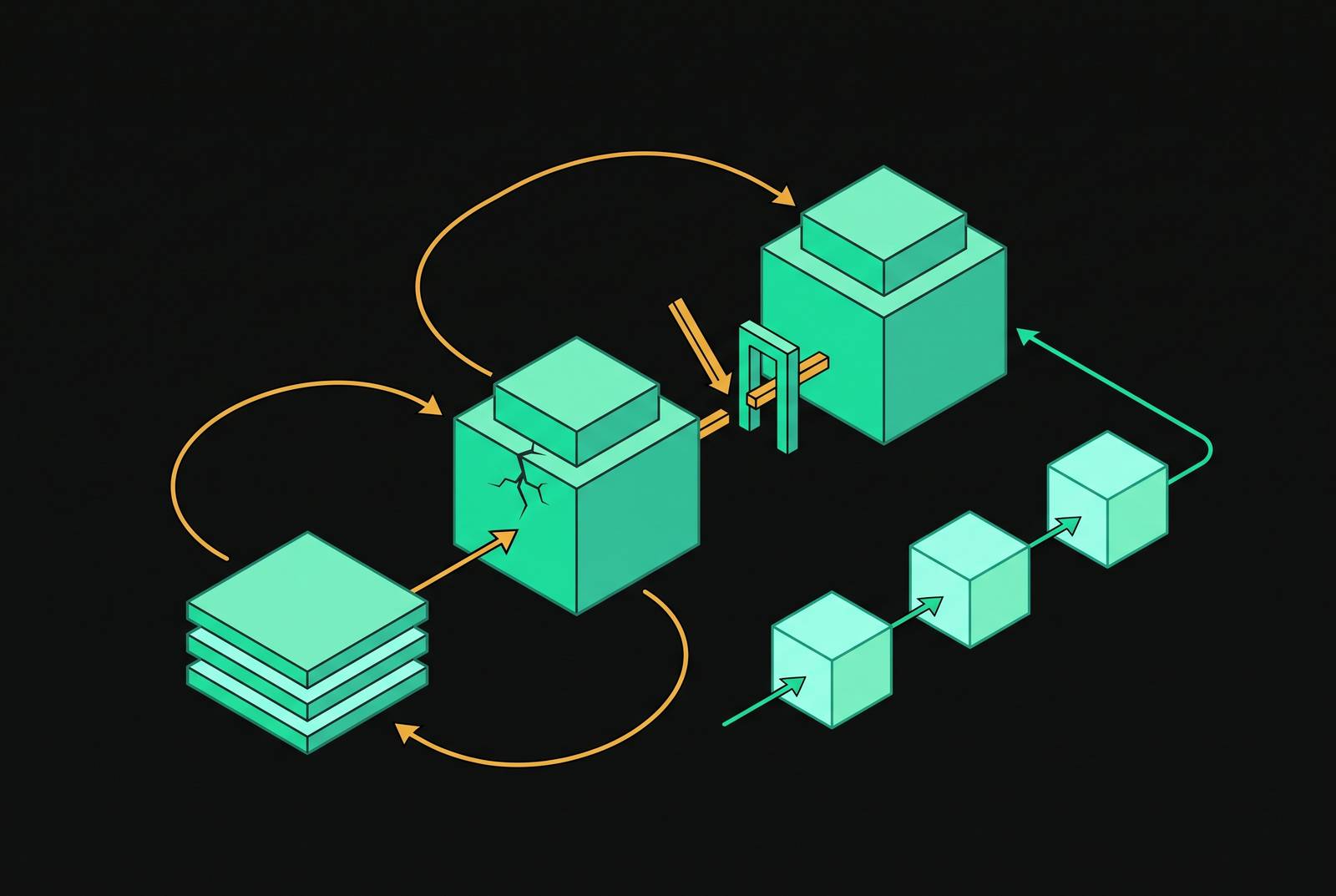
A crash at step 40 of a 200-step agent workflow does not simply end the task. It destroys the accumulated context, the tool outputs, and the credentials built up over the previous 39 steps, unless something outside the agent itself preserved them along the way. That single fact separates fault tolerance for persistent agents from fault tolerance for stateless systems, and it is the premise the rest of this piece works from.
The math behind long-running agent chains punishes small errors severely. A 2026 duration-stratified benchmark measured this directly: mean success rates fell substantially as task duration moved from short tasks to very-long ones. It came from reliability engineering that has not kept pace with what the models are now capable of attempting.
That gap between capability and reliability is the organizing problem of this entire domain. A model that occasionally completes a 110-minute task has demonstrated capability, not dependability. Dependability is a property of the system surrounding the model: the recovery infrastructure that catches a failure at minute 70 and lets the agent resume. Stateless retry, the default reliability tool for most web services, assumes that redoing the whole operation is cheap and that there is no accumulated state to lose. Persistent agents violate both assumptions. Their state is expensive to rebuild, and a retry that doesn't account for what has already happened simply repeats the same compounding failure math from the start.
The failure taxonomy persistent agents face
Production failures in persistent agents are not randomly distributed. They cluster into a small number of recognizable categories, and each category has a recovery strategy that addresses its cause.
Transient failures sit at the bottom of the ladder: timeouts, rate limits, momentary API errors. Fixing coordination failures requires state isolation and a consistent shared context that every participating agent can trust.
Verification failures are quieter and more dangerous. Irreversible-action failures are the highest-stakes category. Anthropic's analysis of a large sample of public API tool calls found that only 0.8% of actions appear to be irreversible, but that small fraction demands an entirely different response: compensation or human escalation, never a retry, because a retry on an irreversible action risks executing it twice.
This taxonomy is a map, not a catalogue to admire for its own sake. The patterns that follow in this piece are not an arbitrary assortment of best practices. Each one exists because a specific failure mode in this taxonomy demands it.
Why retries alone cannot carry a persistent workflow
Retry with exponential backoff and jitter is the correct first response to a transient failure, and it solves a narrow but real class of persistent-agent problems. Applied past that narrow class, or applied carelessly within it, retry creates new failures of its own.
Jitter matters because two agents failing at the same moment will retry at the same moment if nothing randomizes the delay, and that synchronized retry turns a single transient outage into a retry storm that overwhelms the already-struggling dependency. Attempt counts need a hard ceiling too. Some errors that look transient are permanent failures wearing a transient disguise, and an uncapped retry loop burns tokens on LLM calls that are never going to land, which costs real money with no chance of payoff. None of this works unless the underlying operation is idempotent: it produces the same result whether it runs once or five times. A retry without idempotency is not a safety mechanism but a new source of correctness bugs, duplicating side effects that were only ever meant to happen once.
Even with jitter, caps, circuit breakers, and idempotency all in place, retry hits a wall that has nothing to do with how well it's implemented. If step 5 of an 8-step workflow fails and the agent holds no checkpoint of steps 1 through 4, a retry has no choice but to restart from the beginning. Retry answers the question of whether to try again. It has no answer for where to resume from. That question belongs to a different pattern.
Checkpointing as the substrate that makes recovery possible
Checkpointing is the pattern that answers the question retry cannot. It converts a crash at step N from a total loss into a resumption: when step 5 of 8 fails, a checkpointed system picks back up at step 5, with the outputs of steps 1 through 4 still intact.
LangGraph's persistence model illustrates both the promise and the trap here. The framework's in-memory saver loses every checkpoint the moment the process restarts, because it was writing only to memory and nothing durable. The pattern is only as good as the storage backing it. A team that adopts LangGraph's checkpointing API but leaves it on the in-memory saver has built a system that looks recoverable and isn't: the framework makes the pattern available, but the choice of durable storage underneath it is what decides whether recovery actually happens when it's needed.
A controlled experiment in the ADEMA fixed-run matrix makes the same point with data. Across a set of fixed test runs, removing checkpoint and resume capability produced the only invalid run in the entire matrix. That single result is the strongest direct evidence available that state persistence is load-bearing rather than a nice-to-have layered on top of an agent that would otherwise work fine.
Checkpointing solves resumption, but it creates a new risk: replaying already-committed irreversible side effects on restore. The fix is to record, at checkpoint time, which irreversible effects have already been committed to the outside world, and to choose between replaying or forking the run at restore time based on that record. A checkpoint that captures the agent's memory state but not a ledger of its committed side effects is an incomplete checkpoint. That gap, between remembering what the agent knew and remembering what the agent already did to the world, is the seam the next layer of this architecture is built to close.
Snapshot-restore: extending checkpointing to full machine state
Application-level checkpoints capture the agent's logical state: its memory, its conversation history, its position in a workflow graph. A full machine snapshot captures all of it, and that broader scope is what lets snapshot-restore close gaps that application checkpoints leave open.
Trigger.dev's production approach shows what this looks like in practice. The engineering breakthrough that makes this fast enough for production use is seekable compression. Instead of treating the snapshot as one monolithic block that must be decompressed in full before anything can resume, specific memory pages get decompressed on demand, which cuts the memory footprint dramatically and brings restore times down to the sub-second range even at production scale.
The economics matter as much as the mechanism. Snapshot-restore lets the operator pay for storage during that idle stretch instead of paying for live compute that is doing nothing. That shift in the cost structure is what makes a per-user agent model economically viable at scale, rather than a novelty that collapses under its own hosting bill once usage grows.
Google's Agent Substrate demonstrates that this approach holds at fleet scale, not just for a single conversation. It captures the complete memory image and filesystem state of a running process and restores it on any compatible worker pod with matching CPU hardware, which lets thousands of agent sessions share a comparatively small pool of physical machines. Snapshot-restore, at this scale, is the infrastructure layer that makes running a dedicated agent instance per user affordable.
Compensation and semantic rollback when a committed action cannot be undone
Snapshot-restore rewinds the agent. It does not rewind the world. When a side effect has already been committed outside the agent's own boundary, an API call executed, a file written to an external system, a message sent to a real recipient, restoring a snapshot puts the agent back in an earlier state while the outside world remains exactly as the committed action left it. Agent and world are now out of sync, and no amount of further snapshotting closes that gap.
This is the exact failure class that retry and snapshot-restore were never built to solve, and it is the reason compensation exists as its own architectural pattern. Robust Agent Compensation, or RAC, formalizes a deterministic, log-based mechanism for recovering from partial failures using pre-specified compensating actions. A booked flight is paired with a cancel-flight action defined in advance, so that when a multi-step booking process fails partway through, the system has a known forward action that corrects the world rather than an assumption that the original action can simply be erased.
The same discipline explains why naive checkpoint restores are dangerous. The fix is the same one introduced in the checkpointing section: record irreversible effects at checkpoint time, and decide between replaying or forking the run at restore time based on that record.
None of this needs to run everywhere. Anthropic's telemetry across a large sample of public API tool calls found that only 0.8% of actions appear to be irreversible. Compensation is therefore the exception path, not the default one. Some of those irreversible actions will still exceed what any pre-specified compensating action can resolve. They get escalated.
Human-in-the-loop escalation as a designed architectural component
Human oversight in agent systems functions as a recovery primitive built into the architecture, not a fallback bolted on when automation runs out of ideas. Anthropic's telemetry across a large sample of API tool calls found that nearly three-quarters of them involved a human in the loop in some form. Full autonomy is not the production norm; human involvement is.
Escalation only works as a recovery pattern if it carries state with it. An agent that hands a task to a human reviewer and cannot later resume from the exact point of that handoff has not escalated the task. Bounded autonomy architectures make this explicit by encoding operational limits, defined escalation paths for high-stakes decisions, and audit trails that record every action the agent has taken. That audit trail is itself a form of state, and it has to be durable for the same reason a checkpoint has to be durable: without it, there's nothing for a resumed agent, or a human reviewer, to reason from.
Frameworks for trustworthy agentic AI in critical systems treat human-in-the-loop not as a constraint squeezing the agent's autonomy but as a designed safety layer with its own state requirements. A shadow agent monitors the primary agent's checkpointed state and triggers escalation when it detects an anomaly, but it has nothing to monitor if that checkpointed state was never made durable.
Escalation is the top rung of the recovery ladder built across this piece, standing alongside retry, checkpointing, snapshot-restore, and compensation, not above or outside them. Having the right pattern for each failure mode is necessary, but it is not sufficient on its own. Every one of these patterns needs an infrastructure layer that makes durable, trustworthy state possible to produce and read back.
Why isolation at the VM level is the infrastructure requirement
Every pattern covered so far rests on one shared precondition: each agent must own its own state without interference from other agents or from the host environment it runs on.
Shared containers violate the precondition directly. Micro-VM isolation removes that risk by giving each agent its own kernel, its own disk, and its own memory space. A failure inside one VM, including a kernel-level exploit, cannot reach the host or any adjacent VM. Each agent's checkpoint can be trusted independently of what every other agent on the same physical machine happens to be doing.
The sidecar security pattern for agent communications adds a complementary layer on top of VM isolation. The fault-tolerant multi-agent design described in a patent covering shadow-agent failover makes the dependency explicit: a shadow agent fetches the current representation of a primary agent's state from checkpoint storage so it can take over without interruption if the primary fails. That handoff only works if the primary agent's state was stored in isolation to begin with, so the shadow agent can trust what it reads rather than inheriting whatever corruption another process left behind.
None of the patterns in this piece are software-only solutions that can be layered onto any hosting environment.
Applying the full pattern stack: what a production-grade persistent agent looks like
A production-grade persistent agent is not defined by which single pattern it uses but by how completely it covers the failure taxonomy this piece opened with. Transient failures are met with retry, backoff, jitter, and a hard attempt cap. Coordination failures are met with checkpointed, isolated state that every participating agent can read without stepping on another agent's writes. Verification failures are met with validation steps that catch a corrupted output before it propagates further down the chain. Irreversible-action failures, the rare 0.8% of actions that cannot simply be retried, are met with a dedicated effect log and pre-specified compensating actions, with human escalation standing ready for the cases compensation alone cannot resolve.
Every one of those patterns requires durable, isolated state that survives a crash, that distinguishes work already done from work still pending, and that a recovery process, whether that process is a retry, a resumed checkpoint, a restored snapshot, or a human reviewer, can read with confidence. Fault tolerance for persistent agents is a problem in state management first; retry logic, checkpointing frameworks, and escalation protocols are expressions of that deeper discipline, not substitutes for it. A system that gets the state management right earns the right to call its agents dependable, not merely capable.
Sources
- Engineering Reliable Coding Agents: Evaluating and Operating the System Around the Model
- Fault tolerant multi-agent generative AI applications
- Robust Agent Compensation (RAC): Teaching AI Agents to Compensate
- Sidecar security pattern for agent communications
- Engineering Trustworthy Agentic AI for Critical Systems